
There is a moment many women with bladder leaks know too well.
The room is bright.
You are surrounded by people you have to work with.
You are trying to focus.
Then someone says something about your "little bathroom breaks."
Someone laughs.
Someone smirks.
Someone thinks they are being funny.
And suddenly, you are not a person anymore.
You are a punchline.
One woman, who asked to remain anonymous, recently shared her story in a support group.
Her coworkers began calling her a nickname behind her back after she asked her employer for an accommodation for her incontinence.
Nothing costly.
Nothing dramatic.
Just permission to take a five minute break to change if she had an accident.
The accommodation was granted.
The compassion was not.
"I know I am not a pretty potty princess, but it is a small town and now that is my name," she wrote.
"I need a phrase that puts people back in their place without getting me fired."
The gut punch in that message is not the nickname itself.
It is that she needed a "line" to protect herself.
It is that the people who should have responded with maturity responded with ridicule.
And she is not alone.

When Humour Hits Where It Hurts
Humour is supposed to make people comfortable.
Harassment does the opposite.
For women dealing with bladder leaks, jokes can sting sharper than the condition itself.
A 2021 review in the International Urogynecology Journal found that women with urinary incontinence experience significantly higher levels of shame, anxiety, and social withdrawal compared to women without leaks.
Many avoid social gatherings completely.
Many fear long trips.
Many structure their entire day around bathroom access.
Dr. Felicia Grayson, a pelvic health specialist, puts it plainly.
"Urinary incontinence is not a punchline. It is a medical condition that has real physical consequences and a real emotional toll. When women are mocked for it, the shame increases and the condition often worsens."
Bladder leaks affect over 1 in 3 women, according to the National Association for Continence.
The number is even higher for women over 40.
Yet culturally, we treat it like a joke.
Something to laugh about.
Something to tease.
Something to whisper.
But teasing does not land lightly when it hits a place you already feel vulnerable.

Why Nicknames Cross the Line
A nickname sounds harmless until you are the one wearing it.
What that woman experienced is workplace micro harassment that hides behind humour.
It is the kind that HR departments often overlook because the intent sounds "playful."
But intent does not matter.
Impact does.
The impact is:
-
humiliation
-
anxiety
-
hyper focusing on every sensation in your body
-
fear of standing up
-
fear of leaking again
-
fear of being talked about
-
fear of being seen
When someone turns a medical condition into a joke, they chip away at a person's dignity.
They strip away the humanity and replace it with a caricature.

Reclaiming Power Without Getting Fired
You cannot control how others behave.
You can control how you respond.
You can protect your dignity without risking your job.
Here are strategies that protect you emotionally and professionally.
1. Reclaim Your Space. Not the Joke.
You do not need to "own" a nickname you never asked for.
You also do not need to react emotionally to it.
A calm redirect works incredibly well.
"Let's keep it professional."
or
"I prefer to stay focused on work."
Both are HR safe and signal a boundary.

2. Document Everything
Dates. Names. Comments.
Keep it factual.
Keep it discreet.
Keep it saved.
If it escalates, documentation is your shield.
3. Use Confident Neutrality
This is the art of shutting down a joke without giving fuel.
Example:
Coworker: "Princess needs her throne again."
You: "I am stepping out for a moment. Excuse me."
The tone says "Try again, but I will not play."

4. Loop HR In Without Drama
Even a quiet message like:
"I am receiving comments about my medical accommodation. I want to ensure I am supported in maintaining a professional environment."
Professional. Calm. Clear.

5. Support Your Body During Long Days
If you're spending hours at a desk dealing with all this stress, your posture matters more than you think.
Slouching or sitting incorrectly can actually put extra pressure on your pelvic floor, making leaks worse and adding to your discomfort.
A lot of women find that using a posture support cushion helps them sit more comfortably throughout the day without straining their lower back or core.
It's one of those small changes that can make a real difference when you're already managing so much.

6. Talk to One Trusted Person
Research shows emotional isolation makes symptoms worse.
A 2018 study in Neurourology and Urodynamics highlights that women with incontinence who receive peer support report significantly better coping, confidence, and quality of life.
Support matters. Community matters. Being heard matters.
Permission to Do What Works for You
Protection. Liners. Changes of clothes.
These are tools, not admissions of defeat.
If your body needs 24/7 protection to help you function without fear, you have nothing to prove.
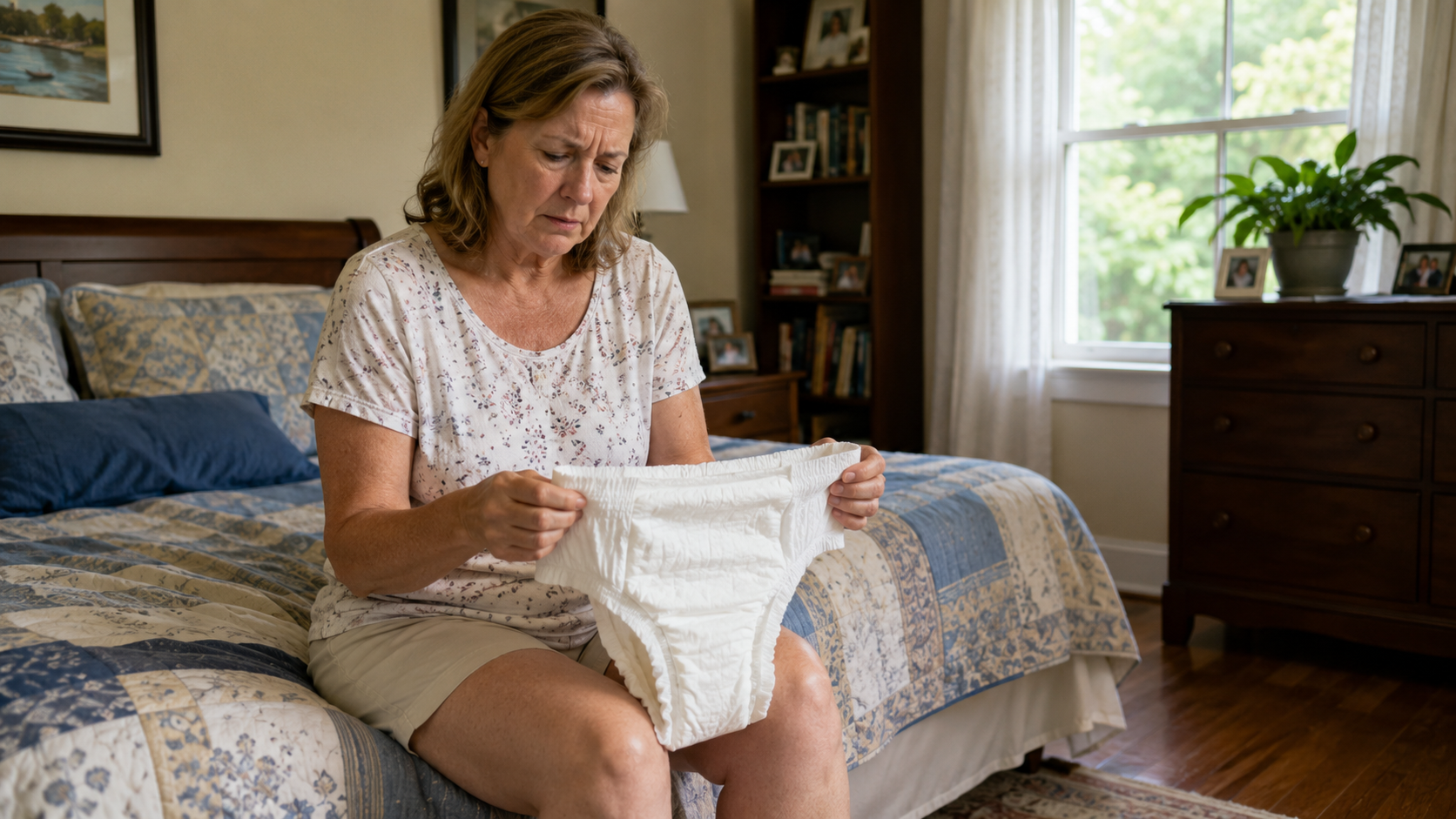
 Some women keep bladder control patches on hand for extra support during the workday. They're discreet, easy to use, and can help reduce sudden urges when you need them most.

Others prefer leak-proof underwear that feels just like regular underwear but offers built-in protection, so there's no bulk, no noise, just quiet confidence.
Whatever you choose, it's about finding what helps you move through your day without constantly thinking about your bladder.
You are protecting your peace. You are managing a medical condition. You are doing what keeps you safe.

When You Finally Get Home
After a day of managing comments, bathroom anxiety, and constant hypervigilance, your body deserves more than just rest, it deserves recovery.
A lot of women are turning to gentle pelvic floor therapy at home using tools like an EMS pelvic massager.
It uses soft electrical pulses to help activate and strengthen the muscles that control bladder function, almost like giving your pelvic floor a quiet workout while you unwind on the couch.
It's not about adding more to your plate.
It's about giving your body the support it needs to actually heal, not just survive.

You Are Not a Punchline. You Are a Person.
The comments from the support group said it best.
"Just hold your head high. As was once said, do not let the bastards get you down."
Women living with leaks carry more strength in one day than most people carry in a month.
The panic, the planning, the self consciousness, the resilience.
It is a quiet battle fought in bathrooms and break rooms and bedrooms at three in the morning.
If someone makes a joke at your expense, it does not mean there is something wrong with you.
It means there is something lacking in them.
You deserve respect.
You deserve comfort.
You deserve to be treated like the adult you are, not a character from someone's lazy joke.
And if anyone calls you a "Pretty Potty Princess," the truth is simple.
You are not a princess.
You are a woman who is trying to live her life with dignity and courage in a world that has not yet learned to grow up.
And there is nothing funny about that.

Share:
How to Sleep Comfortably with Incontinence: Real-World Tips That Actually Work
A Realistic Guide to Travelling With Urinary Incontinence This Holiday